
Dedicated to all your future camper adventures…
Table Of Contents
-
Welcome – pg 2
-
Video Support
-
Owner’s Manual Information
-
Community & Events
-
Service Appointments
-
Legal
-
FWC Team Contact Information
-
-
Quick Camp Guide – pg 5
-
Camper Basics
-
Camper Tips
-
-
Your Camper – pg 6
-
Serial Number/Camper ID
-
MSO
-
Camper Limited Warranty Info
-
-
Installation – pg 9
-
Bed Rail Bolt Down Installation
-
Gear Track Bolt Down Installation
-
Mechanical Camper Jacks
-
How to Unload a Project M
-
How to Load a Project M
-
Truck to Camper Wiring
-
Sealing the Truck Bed
-
-
Safety – pg 12
-
Smoke / Carbon Monoxide Detector
-
Fire Extinguisher
-
Emergency Exit Window
-
Glass and Glazing Materials
-
-
Pop Up – pg 14
-
Gas Strut Roof Lift Assist
-
Raising & Lowering the Roof
-
-
Power System – pg 16
-
12V Power System
-
Pre-Wire & Color Codes
-
Lithium Power Solution
-
Self-Installed Power System Guidelines
-
-
Solar – pg 18
-
Solar Pre-Wire
-
Roof Solar Panels
-
Rear Solar Port & Portable Panels
-
Self-Installed Solar Panel Parameters
-
-
Lighting – pg 19
-
Interior Lights
-
Flood Lights
-
-
Air Systems – pg 19
-
Ventilation & Condensation Tips
-
Roof Fan Operation
-
-
Interior Features – pg 20
-
Wings
-
L Track
-
Cabover Sleep Platform & Mattress
-
Thermal Pack
-
-
Exterior Features – pg 21
-
Visual Key
-
Entrance Hatch Operation
-
Bug Screen
-
Gear Track
-
Roof Racks
-
Roof Tracks Only
-
Yakima Roof Rack System
-
-
Awnings
-
Iron Man Bagged Awning
-
Fiamma Side Awning
-
-
Alucab Shadow 270 Awning
-
Shower Enclosure
-
-
Maintenance – pg 25
-
Interior
-
Clear Window Care
-
Fabric Care
-
Condensation
-
-
Exterior
-
Pop Up Vinyl
-
-
Long Term Storage
-
-
About Four Wheel Campers – pg 26
Welcome to the Four Wheel Camper Family!
Dear New Owner,
Congratulations on your new camper, and welcome to a community built on quality, craftsmanship, and adventure. Your Four Wheel Camper is designed to accompany you through decades of exploration—wherever the road leads.
This Owner’s Manual will help you get the most from your camper, with guidance on operation, care, and maintenance. You’ll also find additional information from component manufacturers included in your owner’s packet.
At Four Wheel Campers, we’re committed to supporting our owners every step of the way. For questions, service, or assistance, please contact us or your local dealer.
We’d love to follow your journey—connect with us on social media @fourwheelcampers and share your adventures using #fourwheelcampers.
Wishing you safe travels and unforgettable adventures, The Four Wheel Campers Team
Video Support
Available videos range from how-to’s, troubleshooting, fun marketing videos and other product information. We frequently add and update our support videos. We hope you find these helpful! Enjoy!
Four Wheel Campers Website: https://fourwheelcampers.com/videos/
YouTube Channel: https://www.youtube.com/c/FourWheelCampers1
Owner’s Manual
A digital version of the Owner’s Manual is available on our website under the Support section: https://fourwheelcampers.com/owners-manuals-for-pop-up-truck-bed-campers/
This manual doesn’t cover every detail of all Four Wheel Campers models. Owners should read it carefully, along with the manuals for individual components included in the Owner’s Information Package. Ultimately, it’s up to the owner to fully understand how to safely and properly use the camper before operating it.
Some features or equipment shown may be optional or not available on all models. Because we’re always working to improve our products, some updates may not be reflected in this manual. The instructions are intended as a general guide and do not modify or extend the manufacturer’s limited warranty.
Community & Events
FWC has a robust, active owner’s community that is friendly and welcoming. The FWC community is a great way to get info, get inspired, and connect with like minded people.
- FWC Events: https://fourwheelcampers.com/events o Owner Rally: Each year FWC hosts an owner’s rally. It’s a great opportunity to connect with the community.
- FWC Facebook Groups o Four Wheel Campers Owners: https://www.facebook.com/groups/FourWheelCampersOwners/ o Used Four Wheel Pop-Up Campers: https://www.facebook.com/groups/617560256689530/
Service Appointments
To make a service appointment at the factory in Woodland, CA, please call our service department at 530-666-1442. Service appointments must be made in advance. All FWC dealers are authorized repair shops as well, please contact a local dealer for more information.
Legal
WARNING! DO NOT RIDE IN CAMPER WHILE VEHICLE IS IN MOTION.
California Vehicle Code § 23116(a) and (b) prohibit any person from riding in or on the back of a pickup truck or flatbed motortruck while it is being driven. A camper is considered part of the truck bed; therefore, passengers must not ride in the camper during transit.
All occupants in a moving vehicle must be properly restrained by a safety belt under Vehicle Code § 27315. Campers are not equipped with seat belts or anchorage meeting FMVSS standards; attempting to ride without a certified restraint system may result in serious injury or death.
California Proposition 65 Warning
WARNING: This product can expose you to chemicals including phthalates and bisphenol A, known to the State of California to cause cancer and reproductive harm. For more information, visit www.P65Warnings.ca.gov.
Reporting Safety Defects
If you believe that your camper has a defect which could cause a crash or could cause injury or death, you should immediately inform the National Highway Traffic Safety Administration (NHTSA) in addition to notifying Four Wheel Campers. If NHTSA receives similar complaints, it may open an investigation, and if it finds that a safety defect exists in a group of campers, it may order a recall and remedy campaign. However, NHTSA cannot become involved in individual problems between you, your dealer, or Four Wheel Campers.
FWC Team Contact Information
Quick contact guide for FWC team and dealers as of 2026. Most up to date information is available on the FWC website. Always feel free to reach out for support!
|
Name |
Location |
Phone Number |
Website |
|
Four Wheel Campers - Headquarters |
CA - Woodland |
530-666-1442 |
www.fourwheelcampers.com |
|
FWC Service Team |
CA - Woodland |
530-666-1442 |
www.fourwheelcampers.com |
|
FWC Parts Team |
CA - Woodland |
530-666-1442 |
www.fourwheelcampers.com |
|
Four Wheel Campers - SoCal |
CA - Greater LA Area |
909-870-1610 |
www.fourwheelcampers.com |
|
Four Wheel Campers - San Diego AKA Basil's Garage |
CA - Vista |
760-996-5764 |
www.basilsgarage.com |
|
|
|
|
|
|
Mule Expedition Outfitters |
AZ - Prescott Valley |
928-800-1349 |
www.dasmule.com |
|
Off-Grid 4x4 |
CO - Fredrick |
720-413-1311 |
www.offgrid4x4.com |
|
AVO Jax |
FL - Jacksonville |
844-667-3687 |
www.ashevillevehicleoutfitters.com |
|
Commonwealth 4x4 |
KY - Lexington |
859-697-2082 |
www.cw4x4.com |
|
Adventure Motors |
MO - Grandview |
816-824-4892 |
www.adventure-motors.com |
|
Four Wheel Campers Jackson Hole AKA Apex Offroad |
ID - Boise |
208-500-9476 |
www.fwcjh.com |
|
Main Line Overland |
NC - Charlotte |
844-656-7626 |
www.mainlineoverland.com |
|
Main Line Overland |
NH - Bow |
844-656-7626 |
www.mainlineoverland.com |
|
Mule Expedition Outfitters |
OR - Tualatin |
503-878-4417 |
www.dasmule.com |
|
Main Line Overland |
PA - West Chester |
844-656-7626 |
www.mainlineoverland.com |
|
Four Wheel Campers Jackson Hole |
MT - Bozeman |
307-690-7404 |
www.fwcjh.com |
|
CB Adventure Supply |
TX - Fort Worth |
817-330-4466 |
www.cbadventuresupply.com |
|
Expedition Superstore |
UT - West Valley City |
801-871-0569 |
www.expeditionsuperstore.com |
|
Mule Expedition Outfitters |
WA - Issaquah |
425-394-1111 |
www.dasmule.com |
|
Go Anywhere |
WI - Eagle |
262-370-4255 |
www.go-anywhere.com |
|
Four Wheel Campers Jackson Hole |
WY - Jackson |
307-690-7404 |
www.fwcjh.com |
|
|
|
|
|
|
Overland Outfitters |
Canada - British Colombia |
778-547-2444 |
overlandoutfitters.ca |
|
Montera |
Canada - Quebec |
450-266-1234 |
montera.co |
|
Wohnkabinencenter |
Germany |
49(0) 2332 83609 |
www.wohnkabinencenter.de |
|
Japan |
Japan |
886-2-86916350 |
www.fairlineinc.com |
Quick Camp Guide
Camper Basics
- Before leaving to Camp: o Plug in the camper’s power source to charge battery (if equipped). o Ensure all systems function properly and topper is properly secured to truck bed.
- Ensure all 6 roof latches are secured (limited campers may have 5 latches).
- Setting Up Camp: o Unlatch all 6 roof latches (limited campers may have 5 latches). o Pop the top!
- Enjoy!
- Leaving Camp: o Secure/put away all items in camper and close all windows and vents. o Turn off lights. o Attach bungees across inside windows and lower the pop top.
- Latch all 6 roof latches (limited campers may have 5 latches).
- Storing Camper: o Air out and dry out camper before storage. o Wipe down all surfaces.
- If storing in damp winter conditions, remove thermal pack and mattress. Periodically pop-up camper and air out.
Camper Tips
- Installation Recommendations o Project M Toppers may experience water and dust intrusion. By nature, truck toppers do not guarantee a complete seal from outdoor elements. o When installed by a dealer or the factory, a rubber gasket will be attached between the camper and truck bed rails to help seal against outdoor elements.
- To mitigate water and dust intrusion through the bed of the truck, Four Wheel Campers recommends the following:
- Aftermarket tailgate gasket to help seal the tailgate area of the truck.
- Sealing any gaps in truck bed using appropriate caulking.
- Using a carpet kit system that covers the bed of the truck (Ex: BedRug).
- Entrance Hatch Functionality o The Project M Topper entrance hatch can be opened from the outside or the inside but can only be locked from the outside.
- To lock the entry hatch for security purposes when parked (leaving the camper):
- From the outside of the camper while hatch is closed, use supplied key to lock each handle lock. To open the locked handles, unlock each handle using key.
- To lock the entry hatch for security purposes when inside (while inside the camper):
- From the outside of the camper while hatch is open, use supplied key to lock each handle.
- Climb inside the camper, then shut the hatch. Handles will be locked from the outside.
- To open the locked or unlocked entry hatch from the inside, grab both small black knobs (one on the back of each of the rear hatch door handles), squeeze them towards the center of the door, and apply outward pressure on the door to open. From the outside, unlock each handle.
- To lock the entry hatch for security purposes when parked (leaving the camper):
- To mitigate water and dust intrusion through the bed of the truck, Four Wheel Campers recommends the following:
Warning! Lock Out Potential: Handles stay locked unless they are unlocked with key. Ensure the hatch does not close while the handles are locked and the keys are inside, or you may become locked out of the camper
NOTE: Do not close the rear hatch using the tailgate molding.
Your Camper (aka Topper)
Serial Number/Camper ID
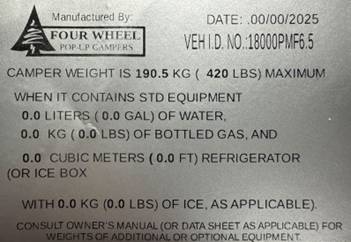
Every new Four Wheel Camper is assigned a unique serial number. The ID tag sticker is normally located on the rear exterior passenger side wall of the Topper. There will also be a duplicate Camper ID tag on an inside wall of the Topper.
The ID tag sticker has the serial number of your camper, manufacture date, dry weight, and other identifying information.
MSO (Manufacturer’s Statement of Origin)
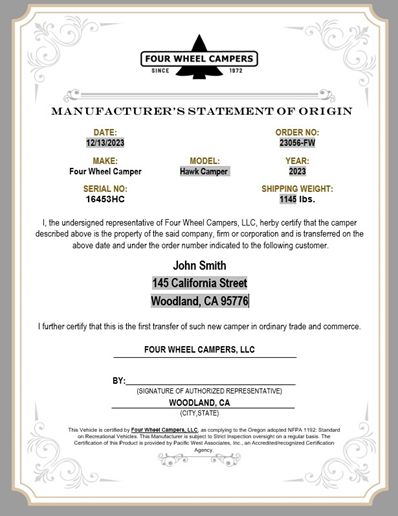
Every new Four Wheel Camper will come with an MSO aka Manufacturer’s Statement of Origin. This is printed and enclosed in the new owner’s packet provided during camper installation. The MSO is typically used for proof of ownership, for resale, for insurance, and for state vehicle registration purposes.
If you plan on selling your camper/topper, most customers will use the back side of the MSO to transfer the title of ownership to the new buyer.
Component Manufacturer Warranty & Info
Each camper will receive a new owner’s packet during camper installation. Manufacturer operating manuals are included, each with their own warranty information. Review the contents and operate these appliances according to the procedures provided in each manual.
Limited Warranty Information
Valid for and only applies to Four Wheel Campers’ truck campers and toppers purchased and used inside the United States and its territories or possessions.
Who May Use this Warranty? This limited warranty extends to the original consumer purchaser only. It does not extend to any subsequent owner or other transferee of the truck camper or topper.
What Does this Warranty Cover? Subject to the exclusions below, Four Wheel Campers warrants that the truck camper or topper sold to the original purchaser will be free from defects as follows:
- Defects in materials, workmanship and the supporting structure of the truck camper and topper, for one (1) year from the date of original purchase.
- Defects in materials and workmanship affecting the structural integrity of the aluminum sidewalls, aluminum framework, floor, and roof of the truck camper and topper, for five (5) years from the date of original purchase.
- Defects in materials and workmanship in the vinyl pop-up enclosure (soft sides) of the truck camper and topper, for a period of five (5) years from the date of original purchase.
The warranty periods set forth above are collectively referred to herein as the “Warranty Period.”
The date of original purchase must be evidenced by a copy of the receipt and the Manufacturer’s Statement of Origin (MSO) from Four Wheel Campers.
What is Excluded from this Warranty? This limited warranty does not cover any damage due to: (1) normal wear and tear; (2) accident, abuse, misuse, neglect, or negligence; (3) the unauthorized modification or repair of the truck camper and topper; (4) use, maintenance or storage other than in accordance with Four Wheel Campers' use, maintenance and storage instructions, including the instructions contained in the Owner's Manual; (5) environmental conditions, including, but not limited to road salt, hail, windstorm, freezing, flooding, fire, or to any occurrence that might be termed an Act of God or Force Majeure; or (6) normal deterioration, fading or discoloration of fabric (including vinyl) and decorative items due to wear or exposure. Consumables such as batteries and similar items are likewise excluded from this limited warranty. Flaws considered to be cosmetic and not structural or affecting the integrity of the truck camper and topper may or may not be repaired or replaced at the discretion of Four Wheel Campers.
This limited warranty does not cover defects in materials and workmanship or any other damage to or caused by truck camper and topper components manufactured by companies other than Four Wheel Campers (example: refrigerators, furnaces, hot water heaters, awnings, roof racks, camper jacks, propane tanks, etc.) or any other product or device installed by you or any third party after the original date of purchase. Such component parts, products or devices may be warranted by their respective manufacturers.
If you need service or repair work on component parts, products or devices not manufactured by Four Wheel Campers, you must contact the manufacturer to have any service or repair work done. Included in the Four Wheel Campers Owner's Manual is a list of manufacturers of component parts originally included with your truck camper or topper, with contact information, and additional details for your convenience.
Four Wheel Campers is not responsible to any purchaser of the truck camper and/or topper for any undertaking, representation or warranty made by dealers during the course of selling the truck camper and/or topper beyond those herein expressed.
Each turnbuckle must be checked periodically to ensure the proper tension is applied. It is VERY IMPORTANT to regularly check & tighten them to ensure no damage is done to your truck or camper/topper. If turnbuckles are not properly adjusted, Four Wheel Campers assumes no liability in potential damage to your truck or camper/topper.
What are the Remedies Under this Warranty? FOUR WHEEL CAMPERS' SOLE OBLIGATION AND ENTIRE LIABILITY UNDER
THIS LIMITED WARRANTY SHALL BE, AT FOUR WHEEL CAMPERS' OPTION, EITHER THE REPAIR OR REPLACEMENT OF
THE TRUCK CAMPER/TOPPER OR THE PARTS THEREOF THAT ARE DEEMED DEFECTIVE BY FOUR WHEEL CAMPERS,
AND FOR WHICH FOUR WHEEL CAMPERS IS NOTIFIED DURING THE WARRANTY PERIOD. FOR PURPOSES OF
CLARITY, NO PAYMENT OR OTHER COMPENSATION WILL BE MADE FOR INCIDENTAL EXPENSES, INCLUDING, BUT
NOT LIMITED TO, TOWING, TELEPHONE, TRANSPORTATION, LODGING, TRAVEL, GASOLINE, LOSS OF PAY OR
INDIRECT OR CONSEQUENTIAL DAMAGE INCLUDING, BUT NOT LIMITED TO, LOSS OF USE OF THE TRUCK CAMPER, INCONVENIENCE, DAMAGE OR INJURY TO PERSON OR PROPERTY, OR LOSS OF REVENUE, WHICH MIGHT BE PAID, INCURRED OR SUSTAINED BY REASON OF ANY DEFECT COVERED BY THIS LIMITED WARRANTY.
UPON RECEIPT OF THE DEFECTIVE ITEM IN QUESTION, FOUR WHEEL CAMPERS WILL INSPECT THE ITEM AND, IF REQIRED UNDER THIS WARRANTY, WILL ATTEMPT TO REPAIR OR REPLACE THE ITEM WITHIN THIRTY (30) DAYS. HOWEVER, THERE MAY BE DELAYS BEYOND FOUR WHEEL CAMPERS’ CONTROL, IN WHICH CASE THAT TIME PERIOD MAY BE EXTENDED AS REASONABLY NECESSARY.
How Can You Obtain Warranty Services? Upon discovery of a defect, you must promptly notify Four Wheel Campers or the authorized dealer from whom you purchased the truck camper in order to request a service appointment. If it is not possible to return the truck camper/topper to the Four Wheel Campers factory or your selling dealer, please call the Four Wheel Campers factory service department. Four Wheel Campers will use reasonable efforts to work with you on finding another possible location to have the truck camper/topper repaired (depending on what the problem might be). However, Four Wheel Campers retains ultimate discretion in selecting the designated service center.
As part of obtaining warranty services at the designated service location, you will be required to provide your name, address and telephone number, proof of purchase, a description of the defect, and any claims number issued to you by Four Wheel Campers. Warranty repairs may only be performed at a service location designated by Four Wheel Campers, which may include the Four
Wheel Campers factory, a Four Wheel Campers authorized dealer, or another service center approved in writing by Four Wheel Campers. Warranty repairs by a non-Four Wheel Campers dealer or service center must be approved by the Four Wheel Campers factory service department PRIOR to any work being started.
In order to obtain warranty services, please contact: Four Wheel Campers, using the following contact information: FWC Service Department: (530) 666-1442 OR The Four Wheel Campers authorized dealer from whom you purchased the truck camper/topper, using the contact information for your authorized dealer included as part of your Owner’s Manual.
Disclaimer and Limitation of Liability Any descriptions, drawings, specifications, samples, models, bulletins, or similar material, used in connection with the sale of the truck camper shall not be construed as an express warranty that the truck camper will conform or comply with your requirements.
EXCEPT FOR THE LIMITED WARRANTY DESCRIBED ABOVE, THERE ARE NO OTHER WARRANTIES MADE BY FOUR
WHEEL CAMPERS ON ANY COVERED TRUCK CAMPER. NO ORAL OR WRITTEN INFORMATION OR ADVICE GIVEN BY
FOUR WHEEL CAMPERS, ITS DEALERS, AGENTS, OR EMPLOYEES SHALL CREATE A WARRANTY OR IN ANY WAY
INCREASE THE SCOPE OF THIS WARRANTY, AND YOU MAY NOT RELY ON ANY SUCH INFORMATION OR ADVICE. THIS
WARRANTY GIVES YOU SPECIFIC LEGAL RIGHTS, AND YOU MAY ALSO HAVE OTHER RIGHTS WHICH VARY FROM
STATE TO STATE AND COUNTRY TO COUNTRY. FOUR WHEEL CAMPERS LIMITS THE DURATION OF ANY LEGALLY
IMPLIED WARRANTIES INCLUDING IMPLIED WARRANTIES OF MERCHANTABILITY OR FITNESS FOR A PARTICULAR
PURPOSE, TO THE DURATION OF FOUR WHEEL CAMPERS' EXPRESS WARRANTY. SOME STATES AND COUNTRIES DO
NOT ALLOW LIMITATIONS ON HOW LONG AN IMPLIED WARRANTY LASTS, SO THE ABOVE LIMITATION MAY NOT APPLY
TO YOU. NEITHER FOUR WHEEL CAMPERS NOR ANYONE ELSE WHO HAS BEEN INVOLVED IN THE CREATION,
PRODUCTION, OR DELIVERY OF THE TRUCK CAMPER SHALL BE LIABLE FOR ANY DIRECT, CONSEQUENTIAL, OR INCIDENTAL DAMAGES (INCLUDING DAMAGES FOR LOSS OF BUSINESS PROFITS, BUSINESS INTERRUPTION, LOSS OF
BUSINESS INFORMATION AND THE LIKE) ARISING OUT OF THE USE OF OR INABILITY TO USE THE TRUCK CAMPER,
EVEN IF FOUR WHEEL CAMPERS HAS BEEN ADVISED OF THE POSSIBILITY OF SUCH DAMAGES. SOME STATES AND COUNTRIES DO NOT ALLOW THE EXCLUSION OR LIMITATION OF INCIDENTAL OR CONSEQUENTIAL DAMAGES, SO THE ABOVE LIMITATION OR EXCLUSION MAY NOT APPLY TO YOU.
IN THE EVENT THAT ANY OF THE ABOVE LIMITATIONS ARE HELD UNENFORCEABLE, FOUR WHEEL CAMPERS' TOTAL
AGGREGATE LIABILITY FOR ANY DAMAGES TO YOU OR ANY THIRD PARTY SHALL NOT EXCEED THE PURCHASE
PRICE YOU PAID, REGARDLESS OF THE FORM OF ANY CLAIM. THIS LIMITED WARRANTY IS GOVERNED BY THE LAWS
OF THE UNITED STATES OF AMERICA AND THE STATE OF CALIFORNIA. THIS LIMITED WARRANTY IS VALID FOR AND ONLY APPLIES TO PRODUCTS PURCHASED AND USED INSIDE THE UNITED STATES (AND ITS TERRITORIES OR POSSESSIONS).
Installation
Depending on the type of camper, topper, and truck, attachment points and installation instructions will vary.
Warning! Always ensure the camper is securely fastened to the truck before driving. An improperly attached camper can cause serious injury and significant damage to both the truck and the camper. Check that all mounting bolts are correctly adjusted and tightened as specified. Four Wheel Campers, LLC is not responsible for any damage or injury resulting from improper installation or maintenance.
NOTE: During your first few trips, the mounting bolts may loosen. Check and retighten all bolts as needed to ensure they remain secure.
Bed Rail Bolt Down Installation
- Project M ‘s are attached with 2-4 bolts through each truck bed rail. Bolt quantities & locations vary based on truck.
- Some trucks require a front spacer plate.
- A double bulb seal is stuck onto bed rail to help reduce water and dust intrusion. There may also be butyl tape in the front corners if rear bed rail and side bed rails have different heights.
- 3/8 x 3” coarse thread bolts with washers and nyloc nuts mount the topper to the truck bed rails through each drilled hole. o Mounting bolts should be tightened to 9 ft. lbs. using a torque wrench. DO NOT OVERTIGHTEN.
- If topper is removed from truck and then reinstalled: o Inspect double bulb seal. If compressed, replace to help reduce water and dust intrusion.
* Use new nyloc nuts on mounting bolts.
Gear Track Bolt Down Installation (Composite Bed Trucks Only)
- Project M campers mounted on trucks with composite beds use the OEM gear tracks and L brackets to secure the topper.
- Ensure OEM bed tracks are securely attached to truck bed.
- L brackets are attached to OEM bed tracks using T nuts, 3/8 x 1.5” bolts, washers and Loctite.
- Project M is aligned with truck bed, and 4 – 8 holes are drilled through the topper and each aluminum L bracket.
- Some trucks require a front spacer plate.
- A double bulb seal stuck onto bed rail to help reduce water and dust intrusion.
- 3/8 x 3” coarse thread bolts with washers and nyloc nuts mount the topper to the truck bed rails through each drilled hole. o Mounting bolts should be tightened to 9 ft. lbs. using a torque wrench. DO NOT OVERTIGHTEN.
- If topper is removed from truck and then reinstalled: o Inspect double bulb seal. If compressed, replace to help reduce water and dust intrusion.
* Use new nyloc nuts on mounting bolts.
Mechanical Camper Jacks
The optional Mechanical Jacks are used to raise and lower the camper for mounting and dismounting the camper on the truck.
- The mechanical camper jacks attach to each corner jack bracket using provided front extension plates, bolts, a socket and wrench.
- Included with the jacks are manual hand cranks and a drill adapter to raise and lower the jacks.
- A cordless drill can be used with the provided drill adaptor to raise or lower the mechanical camper jacks o Warning! Slow down at the end of jack extension or retraction to avoid a hard stop. A sudden stop can cause the drill to jerk unexpectedly, leading to injury or damage to the jack.
- FWC does not recommend driving with the camper jacks mounted to camper or topper. o Warning! Travel with camper jacks mounted to your camper or topper could cause damage to camper if jacks get hit or caught on another object/vehicle.
How to Unload a Project M Topper
Required tools: 4x Mechanical camper jacks w/ hand crank or drill bit adaptor, 2x front extension plates, hand crank or drill (optional), 9/16 socket, 9/16 wrench, and a friend or family member (optional).
- When choosing a location for unloading the camper, select flat & firm ground.
- Warning! Uneven or slopped ground can create unstable conditions.
- Attach 4x mechanical camper jacks using an aluminum extension plate on each front jack, to each corner jack bracket using provided bolts, a socket and wrench.
- Lower the 4x jack base pads close to the ground, but do not touch the camper jacks to the ground quite yet.
- From the inside unbolt mounting bolts that secure the camper to the bed rails or bed track w/ L bracket.
- Lower the 4x jack base pads to the ground using the crank or drill bit adapter and be sure that the pads have solid footing to prevent tipping or sinking.
- Continue raising the front two camper jacks so the front of the camper raises up 3-4” off the truck bed.
- Raise the rear camper jacks 3” - 4” so the entire camper is no longer touching the truck bed.
- Repeat front and rear raising until camper is 4” - 6” above truck bed.
- Visually ensure the camper is high enough and there are no obstructions that will prevent truck from pulling.
- Unplug truck-to-camper wiring if applicable:
- If equipped with FWC Power Solution, then unplug the truck-to-camper wiring harnesses near the rear driver’s side of the camper. There should be one red Anderson plug to unplug and one small wiring harness to unplug for the 3rd brake light connection.
- Drive the truck straight forward until completely free of the camper, taking care not to hit or rub the camper jacks, wheel wells, or tailgate opening.
- To store camper:
- Lower camper using the jacks until the camper is as close to the ground as possible.
- It’s best to store camper on supported surface such as rolling cart, saw horses, X supports or another type of base. Keep jacks on for additional support points.
- Warning! Tipping hazard!
- Do not store the camper on jacks when the jacks are raised, and the camper is standing high up in the air without support.
- FWC does not recommend use of camper while stored on jacks and not firmly attached to a truck. 13) Warning! Slow down at the end of jack extension or retraction to avoid a hard stop. A sudden stop can cause the drill to jerk unexpectedly, leading to injury or damage to the jack.
How to Load a Project M Topper
Required tools: 4x Mechanical camper jacks w/ hand crank or drill bit adaptor, 2x front extension plates, hand crank or drill (optional), 9/16 socket, 9/16 wrench, and a friend or family member (optional).
- When choosing a location for loading the camper, select flat & firm ground.
- Warning! Uneven or slopped ground can create unstable conditions.
- Inspect bulb seal and butyl tape (some campers) that help prevent elements from entering, if compressed or damaged replace with new bulb sea and/or butyl tape.
- Raise the 4x jack base pads from the ground using the crank or drill bit adapter and be sure that the pads have solid footing to prevent tripping or sinking.
- Raise the front two jacks about 3” – 4”, then raise the rear two jacks until the camper is level with the front.
- Always be sure that the front jacks are never lower than the rear jacks; they must always be level with, or higher than the rear.
- Repeat front and rear lifting until camper is 4-6” above truck bed.
- Visually ensure the camper is high enough and there are no obstructions that will prevent truck from backing in safely.
- Line up truck bed with front of camper. It helps to have a partner to guide while backing up.
- Reverse truck straight backward, taking care not to hit or rub the camper jacks, wheel wells, or tailgate opening.
- Check frequently to ensure camper is centered and not going to run into the truck bed.
- Line up front of camper with front bed rail as well as all side rails and tailgate.
- Make sure the bulb seal on the camper or bed rails is lined up correctly to provide a good weather seal. 7) Make sure the topper is properly aligned with the bed rails, and the camper looks lined up from front to back.
- To help with alignment, place bolts through camper bolt holes, then the camper position can be manipulated by lightly pushing camper/camper jacks until bolt holes on truck bed rails or L bracket align.
- Lower the front two camper jacks to allow the topper to gently rest on the front bed rails of the truck bed. Do not completely raise the camper jacks quite yet.
- Next lower the rear two camper jacks so the entire topper is now resting on the truck bed rails. Do not completely raise the camper jacks quite yet.
- From inside of topper check for alignment of mounting bolt holes on the topper and truck. If not aligned, raise topper slightly, adjust topper placement and repeat steps 8 & 9.
- If the topper is lined up correctly:
- Insert bolts with washers through topper mounting holes and bed rails or aluminum L bracket.
- Secure bolt ends with bottom washer and new nyloc nuts.
- Tighten each mounting bolt & lock nut to 9 ft. Lbs. DO NOT OVERTIGHTEN!
- Plug the truck-to-camper wiring together (if equipped with FWC Power Solution). Insert the red Anderson plug into the camper battery to allow the truck to recharge battery while driving. Plug in the harness for the 3rd brake light connection.
- Remove and store jacks in dry location.
Warning! Slow down at the end of jack extension or retraction to avoid a hard stop. A sudden stop can cause the drill to jerk unexpectedly, leading to injury or damage to the jack.
Truck to Camper Wiring (if equipped w/ optional FWC Lithium Power Solution)
To allow for the FWC Lithium Power Solution to charge while driving, the 12v truck to camper wiring starts at truck battery, protected by a MIDI fuse, and is then secured under truck framing to an Anderson SB50 connector plug near rear drivers side of truck bed. On the interior, the plug is connected to the DC/DC charge controller to the battery box (fused on the inside) then from the battery to the fuse block which powers the camper’s electrical system.
Trucks equipped with smart or load sensing alternators will have an additional 14awg yellow cable spliced into an ignition hot circuit on the truck using a fuse tap. This will allow the DC/DC charger to effectively charge the camper despite the voltage fluctuations caused by a smart alternator.
Project M Topper Wiring & Components:
- 8awg Positive/Negative Wires: For toppers with optional FWC Lithium Power Solution.
- 14awg Yellow Ignition Trigger Wire: Only if truck is equipped with a smart alternator.
- 14awg Purple & Black Wire: For 3rd brake light on the rear hatch to meet DOT standards.
- Anderson SB50 Connector: Plug is installed through the rear drivers side bed wall.
- MIDI Fuse
- DC/DC Charge Controller & MPPT Solar Controller: This unit serves as a battery isolator, preventing the truck starting battery from being discharged when the truck is not running.
Sealing the Truck Bed
Project M Toppers may experience water and dust intrusion. By nature, truck toppers do not guarantee a complete seal from outdoor elements.
- When installed by a dealer or the factory, a rubber bulb seal gasket and if needed butyl tape will be attached between the camper and truck bed rails to help seal against outdoor elements.
- To mitigate water and dust intrusion through the bed of the truck, Four Wheel Campers recommends the following: o Aftermarket tailgate gasket to help seal the tailgate area of the truck. o Sealing any gaps in truck bed using appropriate caulking.
* Using a carpet kit system that covers the bed of the truck (Ex: BedRug).
Safety
Always have a clear emergency escape plan and make sure everyone using the camper understands it. Ensure all occupants know the location of the emergency escape and how to use it properly. Never ignore a safety alarm—if one sounds, evacuate the camper immediately. Before traveling, check that all safety device batteries are fully charged and functioning.
Smoke/ Carbon Monoxide Detector (Smoke/CO Detector)
Every camper comes equipped with a smoke/CO detector located on the camper ceiling. Read and follow the instructions on the detector label and in the manufacturer’s owner’s manual.
Warning! Never ignore the sound of a detector alarm!
If there is a detector warning of a potential emergency:
- Turn off all gas appliances.
- Exit the camper immediately and leave door/windows open.
- Close propane tank and/or fuel sources.
- Do not re-enter the camper until the camper has been aired out and alarm returns to its normal condition.
- Determine source of alarm and have all systems checked by qualified RV repair shop.
Warning! Never block Smoke/ Carbon Monoxide Detector (LP/CO Detector).
- Detector should be replaced after 10 years from original camper install date.
- Smoke Alarm o Read and follow the instructions on Smoke/CO Detector label and in manufacturers owner’s manual. o Green LED will blink every 60 seconds (Normal function). o The smoke alarm takes precedence when both smoke and carbon monoxide are present.
- Detector indicator:
- The smoke alarm pattern is three long beeps with voice “Fire!”, a 1.5 second pause, and three long beeps repeating. The red LED blinks in time with the alarm pattern.
- Carbon monoxide (CO) is a colorless, odorless, and poisonous gas. It is formed when incomplete combustion of fuels such as gasoline, natural gas, propane, oil, and wood occurs.
- The following are symptoms of Carbon Monoxide poisoning:
- Mild Exposure: Slight headache, nausea, vomiting, fatigue (Flu like symptoms).
- Medium Exposure: Severe throbbing headache, drowsiness, confusion, fast heart rate.
- Extreme Exposure: Unconsciousness, convulsions, heart and lung failure, brain damage, and death. o Always ventilate camper when using any fuel source. Crack a vent or window! o Read and follow the instructions on Smoke/CO Detector label and in manufacturers owner’s manual.
- Detector indicators:
- The CO alarm pattern is 4 quick beeps with voice “Warning! Carbon Monoxide”, a 1.5 second pause, and 4 quick beeps repeating. The red LED blinks in time with the alarm pattern.
- Detector Testing: Test the alarm operation after the camper has been in storage, before each trip, and at least once per week during use.
- The test/hush switch is located on the front of the alarm. Press and hold the test button for 1 second. The alarm is working properly if the red LED blinks in time with the alarm pattern and both the smoke and CO audible warnings with beeps are heard.
- Maintenance: Vacuum the detector with a soft brush attachment to remove collected dirt and dust every month. Keep the detector away from chemical sprays and solvents which may compromise the detectors’ functions. Do not paint the detector.
- The following are symptoms of Carbon Monoxide poisoning:
- Detector indicator:
Fire Extinguisher
Every camper comes equipped with a Kiddie Fire Extinguisher, located inside the camper near the entrance door.
- Read and follow the instructions on fire extinguisher label and in manufacturers owner’s manual.
- Inspect the extinguisher at least once a month. o Check if the extinguisher is charged. If the extinguisher has a gauge, check that the pointer is within the green section.
- Be sure that the lock pin and tamper seal are intact and in place. o Check for dents, scratches, corrosion or any other damage. o Check the discharge nozzle. Make sure it is clean and free of obstructions. o Discharge and discard after any use.
- Warning! Never test extinguisher by partially discharging. Loss of pressure will occur and render the extinguisher ineffective. It MUST be replaced immediately.
How to properly use a fire extinguisher, use the PASS procedure:
- To use a Kidde fire extinguisher, follow the PASS procedure:
- Pull: Pull the pin and hold the extinguisher upright with the nozzle away from you.
- Aim: Aim the nozzle at the base of the fire and stand back.
- Squeeze: Squeeze the lever slowly and evenly to discharge the extinguishing agent.
- Sweep: Sweep the nozzle from side to side, moving toward the fire.
- You can find the instructions printed on the extinguisher cylinder.
- Fire extinguisher should be replaced immediately after use or discharge.
Emergency Exit Window
Every camper comes equipped with one emergency exit window. The emergency exit window provides an escape route in case your camper must be evacuated under emergency conditions and the path to the main entry door is blocked.
Warning! Never block the emergency exit window.
- Emergency exit window will have labeling and special red markings.
- Small Window 19x26 – Drivers Side. o To operate the emergency exit window, remove screen, pull the red handle(s) and swing the window outward. The window is hinged at the top.
Glass and Glazing Materials
All glazed openings—including windshield, entry-door window, slide-out windows, rear window, and any interior partition—shall be safety glazing materials conforming to Federal Motor Vehicle Safety Standard No. 205, Glazing Materials (49 C.F.R. § 571.205), which incorporates ANSI/SAE Z26.1-1996 performance and marking requirements.
Inspect all glazing quarterly for cracks, chips, or delamination. Replace any damaged pane only with safety glazing materials meeting FMVSS 205. Replacement glazing must be sourced from OEM or FMVSS-compliant aftermarket suppliers.
Pop Up
Gas Strut Lift Assist
The 4x exterior gas strut roof lift assists are installed on the outside of the camper, one set in the front and one set in the rear. They are used to help raise and lower the camper roof.
- The strut pressure will vary from 30 - 50lbs. depending on the size of the camper and roof mounted options.
- Struts typically need to be replaced every 2-5 years depending on conditions. Replacements can be ordered from the FWC Parts Dept. or local FWC dealer.
- Too high of poundage will make it difficult to lower the roof.
Warning! The exterior gas strut roof lift assists are not intended to increase the roof weight load capacity. If a customer has heavy items on the roof, we recommend that the gear be removed from the roof before trying to raise & lower the camper roof. FWC does not recommend more than 100lbs of gear on the camper roof at any one time.
Raising & Lowering the Roof
Raising the Roof
- Release all 6 (5 in select models) roof latches located around the perimeter of the camper. The cam latches (roof latches) are released by pulling the latch handle downward, which releases the tension between the roof bracket and the latch connector. Pull down on the roof slightly and pull the latch connector off and away from the roof bracket. The latch connector will now be resting against the latch handle in a down position.
- Warning! Ensure that the latch connector does not stay hooked to the roof bracket. If the latch is still connected the roof frame can be bent, creased, or otherwise damaged as the roof is pushed upward. If there is pressure when trying to lift the roof, go out and check that all latches are unlatched!
- Open the camper door to allow the camper to fill with air as the roof is raised. If the door is left closed, it will create an airtight vacuum and will make lifting the camper roof VERY difficult to pop up.
- Raise rear of roof
- Stand at rear of camper near the rear lift panel with door open.
- Pushing slightly upward on the rear folding panel, release the barrel latch that supports the end panel when the roof is down. Watch fingers!
- Place one hand on the rear horizontal wooden push board which is located on the ceiling and push the roof upward, at the same time, push up and outward on the lift panel with the other hand until the lift panel is extended vertically. It’s easiest to mostly push upwards on the wooden push board, instead of trying to push the black folding lift panel.
- Before the panel is all the way up, locate and pull the strap free from behind the panel, then snap the panel into place vertically by wrapping strap around panel nob and snaping into place.
- Raise front of roof
- Stand facing cab of truck, at the front of the camper with bed slide in stowed position. Unbutton front push handle from storage position on ceiling.
- Place one hand on the front horizontal wooden push board which is located on the ceiling and push the roof upward, at the same time, grasp the push handle and push forward until the lift panels are fully extended and lock into place with the button strap around the end of the handle. It’s easiest to mostly push upwards on the wooden push board, instead of trying use the push handle.
- Remove and store the bungee cords that pull vinyl pop up material inward.
Lowering the Roof
- Prepare camper: Clear all objects from bed, close fan cover(s), and turn off all lights.
- Close all window flaps on the inside of the camper. Run fingers, pushing gently, along the side edges of each window along the welt that have the Velcro strips attached to them. Ensure a tight seal to keep any possible moisture from entering the camper while traveling. Attach bungee cords to window D rings, so that vinyl pulls in when roof closes. 3) Open the camper door so the air inside the camper can be released as the camper roof comes down.
- Lower front of roof
- Unsnap the strap from the pull handle in front cabover bed area.
- Using the push handle, slowly lower the front part of the roof by pulling the handle towards the center of the camper, and using the other hand on the front wooden push board to slow the roof from coming down too quickly.
- Lower back of roof
- Unsnap the strap that is around the knob on the rear folding panel.
- Place one hand on the rear wooden push board, then pull the knob on the folding panel down until the roof comes down on the rear. Keep one hand on the wooden push board to slow the roof from coming down too quickly and keep the other hand on the knob that is attached to the black folding panel.
- Be sure to keep hands and fingers clear to avoid getting pinched as the panel nears the fully closed position.
- Secure rear lift panel using barrel latch by slightly pushing up on the lift panel to align the hole.
- Close all 6 (5 in select models) roof latches located around the perimeter of the camper. The cam latches (roof latches) are engaged by attaching latch connector to roof bracket then pushing latch handle upward, which creates tension. Do not overtighten.
- Warning! Ensure that all latches are latched! If not, then pop up vinyl or roof may be damaged by driving at high speeds. You don’t want to be the one driving with your top up!!!
Warning! A HEAVY LOAD CAN FORCE THE ROOF TO COME DOWN VERY QUICKLY AND CAUSE INJURY OR CAMPER
DAMAGE. Remove any snow load from the roof before lowering it.
Power System
12 Volt Power System
The Project M Topper is pre-wired for power, giving the ability to add a 12V battery system by choosing the FWC Lithium Power Solution options or installing a self-provided 12V power source. Pre-wire includes wiring to interior ceiling lights, roof vent fans, rear flood lights and roof/rear solar panel ports. A 12v power source is needed to power lights and fans installed in the camper. Each Project M Topper comes standard with a basic fuse panel installed in the interior rear driver’s side corner.
Note: Camper powered accessories will not function unless connected to a 12v power source.
Warning! 12V DC power source is required. Never connect camper pre-wiring directly to a 120V AC power source. Damage to wiring, power source or other connected components may occur.
Pre-Wire & Color Codes
12v camper wiring terminates at the fuse box. Solar wiring is concealed inside wire raceway and the fuse box load wires along with the 3rd brake light wires are located at the driver’s side rear corner of the unit.
- 8awg Red & Black Wires = Solar Panel Pre-Wiring (in raceway)
- 8awg Red & Black Wires = Camper Load Wiring (at rear drivers side corner)
- 14awg Purple & Black Wires = 3rd Brake Light (at rear drivers side corner)
- 14awg Yellow & Black Wires = Interior Ceiling Lights & Power Roof Vent Fans (terminated at fuse panel)
- 14awg Green w/ small Yellow Stripe & Black Wires = Rear Flood Lights (terminated at fuse panel)
Lithium Power Solution (optional)
Included Parts: Lithium battery w/ battery box and USB/12V outlets, Anderson plug, proper fusing, 750-Watt portable inverter, 8amp battery charger and truck to camper wiring for truck charging.
- Power Solution is installed on rear passenger wing secured using L track w/ strap. Always ensure battery box is properly secured before travel.
- To use 12v accessory plugs (USB, 12v), flip orange switch to the on position.
- There are 3 ways to charge battery of Lithium Power Solution: o 120V AC Plug: Via 8amp battery charger connect to a standard 120V AC power outlet.
- Truck Charging: Via installed DCDC that charges battery while driving.
- Solar: Using pre-wired roof or rear solar port and DCDC w/ solar controller.
- Truck-to-Camper Wiring Plug o Connect red SB50 connector to the left side of the Power Solution, then camper battery will charge when truck is running.
- Victron Battery Monitor Display & App o The battery has Victron Battery Monitor display and is bluetooth compatible. This monitors inbound and outbound wattage and amperage and will display the net total as well as percentage of battery remaining. o The display shows a net value for current and wattage, rather than separate values for charge/discharge. Example: If there are 10 amps of load (fridge, fans, lights), and 15 amps of solar charge coming in, the display would read a positive value of 5 amps. If the load grew to 20 amps with the same 15 amps of solar input, the display would read a negative value of 5 amps.
- Portable 750 Watt Inverter o Connect red SB50 connector to right side of the Power Solution to use regular 110v accessories that draw less than 750 watts.
- Lithium Battery Information
- High quality lithium batteries contain an internal battery management system, or “BMS”. This acts as the brain of the battery and monitors multiple parameters to maintain the safety of the battery. The BMS will monitor under/overvoltage, under/over temperature, and over current situations. If any of these parameters reach a particular threshold, the BMS will “engage” and shut off the battery internally to stop and power transfer in or out of the battery. The most common instances of BMS engagement are as follows:
- Low temperature: The BMS will engage to prevent charge/discharge if the temperature is around freezing temperatures. On batteries with physical heating toggle switches, ensure that the heaters are in the on position to prevent the battery from shutting down in cold temperatures. Heater characteristics vary depending on the battery in the camper, but the main goal is the same: keep battery cell temperatures above 32F.
- Low voltage: If the battery is fully depleted, the BMS will engage and shut off battery to prevent excessive discharge. While lithium batteries can safely discharge to 0%, it is not recommended to discharge past 10-15% to avoid the risk of engaging the BMS.
- If the BMS shuts battery off: The battery voltage will drop to a low 1-2 volt value, and will need to be “woken up” by an incoming charge source once the underlying condition has been resolved (low temperature, low state of charge). This can usually be accomplished by connecting the 8 Amp shore battery charger to a 120V AC power source. Allow battery to charge to 100%.
- Battery Maintenance: Lithium batteries do best when stored at 50%-85% capacity. The lifespan of lithium batteries is lengthened if they do not rest for prolonged periods at low voltages or stored at full capacity. If storing the camper for an extended duration, please reference battery User Manual for information on how to properly store battery. Periodically check battery charge and top off as needed.
Power System Requirements
Utilizing the camper pre-wire, an external 12V battery power source can be connected. A 12V DC power source is required, ideally with at least a 25amp output. Running at less than 25 amps runs the risk of overloading the battery system depending on what is using power.
Warning! 12V DC power source is required. Never connect camper pre-wiring directly to a 120V AC power source. Damage to wiring, power source or other connected components may occur.
- Power Source: 12V DC only
- Power Output: Minimum 25amp output is recommended to run max camper power draw in addition to other accessories. Consider what else will be powered (Ex: device charging, portable refrigerator).
- Circuit Protection: Ensure adequate circuit protection between power source output and camper with a fuse or circuit breaker that is rated at 25amps.
- Power Source Examples o FWC Lithium Power Solution (132ah): Comes connect to the camper with truck charging and is solar ready. Can also be added later by a dealer.
- Power Station: Various off the shelf power stations meet the minimum 25amp power output and will typically have other charging capabilities. (Ex: Redarc, Goal Zero, Bluetti, Aferiy)
- DIY System: Involves hooking up a battery and controller to the 12v camper power. Research & knowledge of electrical systems required.
- If connecting an aftermarket power supply, follow all manufacturer specifications and instructions.
Solar
Solar Pre-Wire
There are pre-wired solar plugs in two locations on the camper. On the roof is an MC4 connector which allows for roof solar panels to be added at time of installation, or at a later date. On the rear drivers side is an SAE plug for use of portable solar panels.
- If equipped with FWC Power Solution, then camper has a DC/DC with a MPPT solar charge controller. o The 8awg solar positive wire terminates at the DC/DC charger w/ Solar Controller and the 8awg solar negative wire goes to aground bar.
- If equipped with pre-wire only, the 8awg positive and ground wiring ends are located at the rear drivers side wall. Wiring may be concealed inside wire raceway. It is not recommended to pass more than 30amps through any stretch of solar wiring.
Roof Solar Panels
The optional Overlander Solar panels are attached to the center of the roof using a section of roof track and plugged into the MC4 connector. The panels come in 2x 80w, 2x 125W and 4x 125W configurations depending on camper size. Dual panels allow for better charging if one panel is obstructed. The panels start generating power as soon as there is visible light, which maximizes the total power over the day.
- Keep solar panels clean and free of obstruction for maximal solar power.
- Low light or winter conditions will effect the amount of solar generation.
Rear Solar Port & Portable Solar Panels
The SAE solar plug installed on the rear wall of the camper allows for use of a portable solar panel. If more solar generation is needed or if parked in the shade, a portable panel can allow for added solar and different placement locations.
If equipped with FWC Power Solution:
- The 8awg solar positive wire terminates at the DC/DC charger w/ Solar Controller and the 8awg solar negative wire goes to a ground bar.
- Total open circuit voltage of all solar connections needs to be less than 32V.
- Total solar output amperage not to exceed 20amps.
- Total solar watt input not to exceed 375W.
- NOTE: Check the + and - polarity of the portable solar panel to ensure it matches with SAE plug polarity.
Solar System Requirements
- Total Solar Output: Total solar output should not exceed 25amps total from roof and rear plugs combined.
- There are 2 pre-wired solar connectors: o Roof MC4 Plug: Solar output not to exceed 25amps.
Rear SAE Plug: Solar output amperage not to exceed 10amps.
- NOTE: Check the + and - polarity of the solar panel to ensure it matches with SAE plug polarity.
- An MPPT solar controller (integrated or stand-alone) is required to connect solar into a power system.
- If connecting to an aftermarket power supply, follow all manufacturer specifications and instructions.
Warning! If attempting to self-install a solar system in a Four Wheel Camper, the customer assumes all responsibility for the correct wiring, polarity of wiring, and installation. It’s important to know how to use a voltmeter, basic wiring techniques & code, understand how to install in-lines fuses and check the polarity of the wiring. Every solar company uses different wiring and different polarity of solar plug connections. Four Wheel Campers, LLC will not be responsible for wiring shorts, solar panel shorts, or fried charge controllers due to incorrectly installed solar or wiring by the customer.
Lighting
The Project M Topper must be hooked up to a 12V power system for installed lighting to function.
Warning! Never connect camper pre-wiring directly to a 120V power source.
Interior Lights
All campers are equipped with 4x LED ceiling lights and are individually controlled.
- To turn on an induvial ceiling light, press either white amd/or amber button on light then press again to turn off.
- Press and hold the button to adjust brightness.
Flood Lights
The optional flood lights are very bright and great for setting up camp or seeing around a campsite.
- To turn on, locate accessory switch panel just inside rear drivers side camper door and flip rocker switch upwards.
- The flood lights are slightly adjustable by using the swivel mounting bracket on the back of each light.
- If camper was not ordered with flood lights, there will be pre-wire run to mounting locations.
Air Systems
Ventilation & Condensation Tips
It’s always good to have ventilation in the camper, there’s nothing like fresh air! To minimize condensation:
- Crack a roof vent open along with the corner of a window to allow for airflow.
- Condensation is promoted by moist conditions, internal/external temperature differences and/or breath.
- If condensation does occur, wipe down damp areas before lowering the roof. As soon as possible, allow camper to completely air out and dry.
- If camper lives in cold, wet, or snowy conditions, it’s good to remove mattress and thermal pack during winter storage and pop up camper periodically to air it out.
Roof Fan Operation
- Camper must be connected to a 12v power system to function.
- Use the ON/OFF button to start the fan or to turn off the fan.
- Press both the up and down arrow at the same time to fully open or close vent w/o using fan.
- Use the IN/OUT button to reverse the direction of the fan. The fan will slow down and pause for 2 seconds before resuming operation in the opposite direction.
- The AUTO mode allows the thermostat to turn the fan ON and OFF depending on the thermostat setting. Press this key once for less than 3 seconds to enter AUTO mode, 3 quick beeps will confirm the fan has entered Auto Mode. To Exit Auto mode, press the ON/OFF key. The Green LED light will light to indicate the fan is in Auto Mode. Please refer to the manual for adjustment instructions..
- Knob: Pull to unlock prior to turning. Rotate the knob clockwise to close the vent lid, and counter-clockwise to open the vent lid. Push inward to lock when vent lid is open or closed.
- The remote control allows for full control of the fan while in bed or outside of the camper. A unique feature only available via the remote is a custom Temperature Setting for AUTO mode. If AUTO mode is on, the fan will activate/deactivate when exceeding or dropping below the set temperature.
- Rain sensor: Engage the rain sensor and fan will automatically close when detecting rainfall.
Interior Features
Wings
All Project M’s are equipped with an interior wing on each side of the camper, 13.5 inches wide. These wings provide structural support as well as allow for variable bolt mounting locations for different truck types.
Warning! FWC does not recommend modifications (drilling/cutting) to the wings. Modifications could alter structural integrity of the camper and voids warranty.
NOTE: The maximum dynamic (driving, in motion) load limit is 150lbs. The maximum static (stationary, not in motion) load limit is 450lbs.
Interior L-Track
The optional Interior L-Tracks can be a useful tool for mounting items to the inside of the camper. Various mounting connectors, clips, and hanging hooks are available online (search key words: hook clip airline track aluminum extrusion).
NOTE: The maximum load limit is approx. 50 lbs. spread evenly across each gear track.
Cabover Sleep Platform & Mattress
- To extend the cabover bed platform: o Grab center of the aluminum slide-out platform and pull it out to extend bed to the end of the bed rails. o When pulled out all the way, the aluminum slide-out platform will drop into place and sit flush with the cabover.
- If the topper is equipped with optional factory mattress, place the 4 smaller mattress insert cushions into place to fill in the entirety of the cabover bed area.
- To store bed platform: o If equipped with optional factory mattress, remove the 4 small mattress insert cushions and set aside.
- Grab the center front rail of the aluminum slide-out platform and lift upward while pushing inward. This will allow the aluminum slide-out platform to hop up on the cabover portion, and then can be pushed all the way forward, flush with the front wall of the camper.
- Completely stow the platform & cushions for save travel.
- NOTE: Move mattress to a dry location if camper is stored in wet conditions.
Thermal Pack
The optional thermal pack is intended to help with heat or cold retention and create an air barrier between pop up vinyl and interior of camper. It also helps with light entering the camper. All campers come equipped with upper and lower Velcro to affix optional thermal pack into place. To order a thermal pack, please contact the FWC Parts Department or local dealer.
- General Care: o Spot clean with lukewarm water and gentle soap. o It is not recommended to launder the thermal pack in washing machine as damage may occur.
- Air dry, do not iron.
- To install thermal pack: o Start on one side by aligning thermal pack windows with pop up windows. Flaps should open downward.
- Moving from the center out press thermal pack to upper Velcro ensuring it is taught and still aligned with windows.
- Press thermal pack to lower Velcro ensuring it is taught. o Continue toward one corner of camper. o Tuck any remaining fabric behind the black folding lift panels.
- Complete attachment to other corner and tuck. o Repeat on other side of camper.
Exterior Features
Visual Key
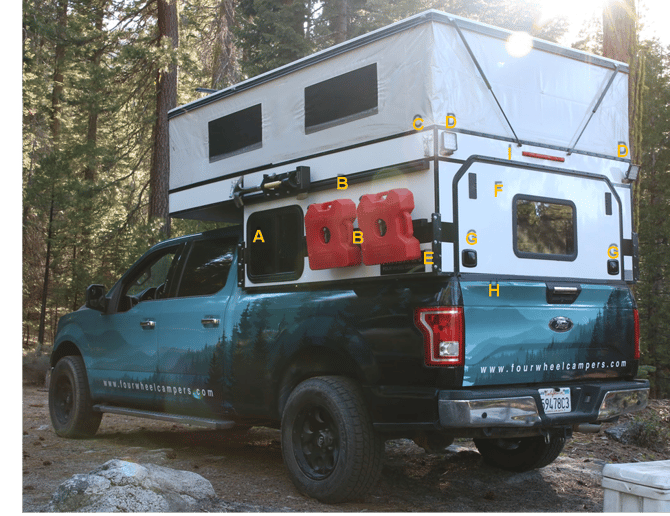
A. Emergency Exit Window
B. Gear Tracks w/ Mounted Accessories
C. Roof Cam Latch (6 Total, limited models 5)
D. Flood Light
E. Aluminum Jack Bracket
F. Rear Access Door
G. Locking Door Handles
H. Tailgate Molding
I. Third Brake Light
Entrance Hatch Operation
The Project M Topper entrance hatch can be opened from the outside or the inside but can only be locked from the outside.
Warning! Lock Out Potential: Handles stay locked unless they are unlocked with key. Ensure that hatch does not close while the handles are locked without the keys or camper will be locked resulting in being locked out of camper.
- To lock the entry hatch for security purposes when parked (leaving the camper): o From the outside of the camper while hatch is closed, use supplied key to lock each handle lock.
- To open the locked handles, unlock each handle using key.
- To lock the entry hatch for security purposes when inside (while in the camper): o From the outside of the camper while hatch is open, use supplied key to lock each handle. o Climb inside the camper, then shut the hatch. Handles will be locked from the outside.
- To open the locked or unlocked entry hatch from the inside, grab both small black knobs (one on the back of each of the rear hatch door handles), squeeze them towards the center of the door, and apply outward pressure on the door to open.
- From the outside, unlock each handle.
NOTE: Do not close the rear hatch using the tailgate molding.
Bug Screen
The optional entrance bug screen is intended to help keep bugs from the interior of camper. It is made to fit the dimensions of the entrance hatch. To order a bug screen, please contact the FWC Parts Department or local dealer.
- To use bug screen zip sides, allow screen to hang fully down and center magnets to engage. Screen is gusseted to allow for use of the zippers.
- Stow away by snapping bottom button to top, roll screen to top, then use Velcro straps to secure screen up out of the way.
- Stow to the side by parting magnets, gather screen to each side of the camper, and use side button straps to secure screen out of the way.
- Spot clean with lukewarm water and gentle soap.
Exterior Gear Tracks
The optional Exterior Gear Tracks are a useful tool for mounting items to the exterior of the camper.
- To mount accessories to the gear track: o Remove end cap, then slide a 3/8 hex head bolt(s) into the track into preferred position and use a washer and nut to secure. The bolt length needed will vary depending on the thickness of the brackets you are trying to attach.
* There are also various t-nuts, mounting connectors, and hanging hooks available online (search key words: 80/20 extrusion insert clips hooks).
NOTE: The maximum load limit is approx. 50 lbs. spread evenly across each gear track.
Roof Racks Roof Tracks Only
The optional roof tracks are a useful tool for mounting items to the roof without modifying camper. The roof tracks come with various sliding t-nuts installed and can be used with M6-1mm bolts to secure items to the camper roof. The roof tracks will vary in length & width depending on camper model and roof length.
NOTE: The maximum load limit is 100lbs spread evenly across camper roof.
Yakima Roof Rack System
The Yakima Complete Rack Roof System will include Yakima tracks, control towers, landing pads, cross bars, lock cores, and a set of keys. This rack is intended for carrying small, lightweight items while trying to minimize wind drag. The cross bars are set at a factory standard distance apart, spacing can be adjusted. Please follow the Yakima user manual.
NOTE: The maximum load limit is 100lbs spread evenly across camper roof.
Awnings
NOTE: To protect awning, best practice is to stow it away if there is wind or anytime campsite is unoccupied.
6’ Bagged Style Awning
- Set Up
- Unzip the protective cover and fold back from the awning.
- Undo the Velcro straps and release the fabric.
- Take note of how the fabric is layered. This will assist with pack up.
- Swing the horizontal poles out from the awning body located closest to the vehicle
- Insert the long spigot into the extrusion at the end of the awning.
- Grip the pole on either side of the plastic cam lock twisting in opposing directions to lock the pole length in place.
- Swing the horizontal support poles down from the end located furthest from the vehicle.
- Adjust height to suit and grip each pole on either side of the plastic lock and twist in opposing directions to lock the pole height in place.
- Secure the fabric to the horizontal poles with the Velcro strips. These are located along the length of the awning.
- Attach Guy Ropes if required and secure firmly in the ground using the supplied pegs.
- In the event of rain, adjust the support pole height to create a slight slope away from the vehicle.
- Pack Up
- If time permits, allow the awning material to fully dry out before packing away. Allow awning to thoroughly dry out before any long-term storage to prevent damage to the material and mechanisms.
- Remove Guy Ropes and pegs from support poles and pack away.
- Release the tension on the plastic cam locks and collapse the support poles, swinging back into the awning end farthest from the vehicle, locking into place.
- Undo Velcro strips securing horizontal poles to the material and release the tension on the plastic cam locks.
- Collapse and swing the horizontal arms back to the awning main body and secure in place.
- Carefully and tightly roll the awning material back towards the main body, reversing the set up procedure and secure in place with Velcro straps.
- Refit cover over the entire unit and zip up. Be careful not to catch the awning material in the zip.
Fiamma Side Awning (8’)
- Set Up
- To open the side awning use provided crank handle pole found inside the camper.
- Attach the hook on the end of the crank handle to the eyelet on the end of the awning.
- Gently crank the handle counter-clockwise and let the awning come out about one foot.
- Look inside the leading edge of the awning case and gently pull outward on both ends of the left awning leg.
- Once the leg is free from the back of the awning case it should rotate freely downward. Lower the awning leg/foot down to the ground and tighten the adjustment knob so that the awning leg will support the weight of the awning. Repeat these steps for the awning leg on the right side.
- Proceed to extend the awning out, but do NOT extend so far that extension arms are straight- they should still have a slight angle. Overextending puts a stress on the linkage and makes it more difficult to retract the awning. The slight angle is also stronger, and will keep the awning in better mechanical condition for much longer.
- In windy conditions, stake down if needed.
- Pack Up
- Retracting the awning is the reverse of extending it.
- Keep the pivot points on the legs lubricated with a spray Teflon type lubricant to ensure smooth operation.
- When folding the retracted legs into the awning casing, ensure the thumb screws are tightened slightly after stowing to avoid loosening and loss.
- Allow awning to dry completely before storage.
Alu-Cab Shadow 270 Awning
- Set Up
- Open zip and flip the bag clear of the hinge.
- Undo the three Velcro straps.
- Grab all the arm ends and lift out of the cradle.
- Grab the strap on the top arm and pull it while waking to the rear of camper. Make sure that bystanders keep clear!
- Clip the strap onto the rail at the back of camper.
- Tighten the strap by pulling the loose end of the strap away from the cam buckle.
- Raise the center bar on the middle arm until it locks into place.
- If required, drop the center support leg. Loosen the thumb screw and then pull the support foot out of its housing.
- With the foot of the center support leg on the ground, raise the awning slightly, and tighten thumb screw on the pole.
- If required, deploy the guy ropes from the awning arms.
- Pack Up
- Retracting the awning is the reverse of extending it.
- Grab the two lower canvas folds and roll the canvas upwards.
- When the third canvas fold is exposed, include it into the roll and carry on rolling upwards until the canvas roll is tight against the awning arms.
- Secure the canvas tightly with the three Velcro straps.
- Close the awning zip towards the rear of the vehicle.
- Allow awning to dry completely before storage.
Shower Enclosure
- Set up
- Unzip the transit cover and release the retaining straps to unroll the curtain.
- Pull the shower tent frame gently to engage the gas struts for self-deployment.
- Secure all corners with stakes.
- Warning! Be sure that shower enclosure is clear of any hot air exhaust from furnace or water heater. Use rear zip flap if needed. Damage can occur.
- Pack Up
- Remove stakes and items from internal pockets.
- Fold the tent by pulling down the pack down strap while pushing the frame towards the baseplate.
- Ensure the curtain is flat, then roll it up from the bottom and secure it with velcro retaining straps.
- Zip up transit cover. Ensure that zipper does not catch on material when zipping up. If having trouble closing, the curtain roll may not be tight enough.
- Allow shower enclosure to dry completely before storage.
Maintenance
Interior
Interior Clear Vinyl Windows
- Only use warm water with a soft cloth to clean the clear plastic window flaps. Do not use any window cleaners!
Mattress Care
- Spot cleaning is recommended with water and mild soap. The affected area should be blotted, not rubbed to prevent permanent stains.
- Fabric covers should only be hand washed and air dried. Do not machine wash or use a dryer.
- Storage: Always remove the upper bed cushions of the camper after each trip to allow any possible condensation to dry.
Condensation
- Wipe moisture and allow camper to air out to completely dry after each trip or if planning to store for an extended period. • Storage: Always remove the upper bed cushions of the camper after each trip to allow any possible condensation to dry. Store in a dry place until next use.
Exterior
The camper has aluminum siding with automotive finish and a one-piece aluminum roof. There are various ports and doors located around the campers.
- Hard Side Aluminum o The hard sides/body of the camper can be washed with a mild soap like Aerospace 303 Multi Surface Cleaner or Protect All. o Warning! Do not use high pressure to wash camper or take camper through an automatic car wash. Damage can occur.
- Soft Side Pop Up Vinyl o The soft sides/pop up portion of the camper can be washed with mild soap like Aerospace 303 Multi Surface Cleaner or Dawn dish soap.
- For extra tough marks, spot clean using a cleaner like Bixler’s Orange Off, a magic eraser and some elbow grease o Treat vinyl inside and out with 303 Marine and Recreation Aerospace Protectant once a year to protect from UV damage.
- Before long term storage ensure vinyl is clean and dry. o NOTE: Do not use Armor-All, the oil can damage vinyl.
Long Term Storage
For long term storage the following is recommended:
- Camper should be clean and dry.
- Move mattress to a dry location if camper is stored in wet conditions.
- Turn off all electrical items.
- Periodically check on camper, batteries and air out.
About Four Wheel Campers
https://youtu.be/QSUsxwHrVyk?si=3G2hvZHZmguFm2pt
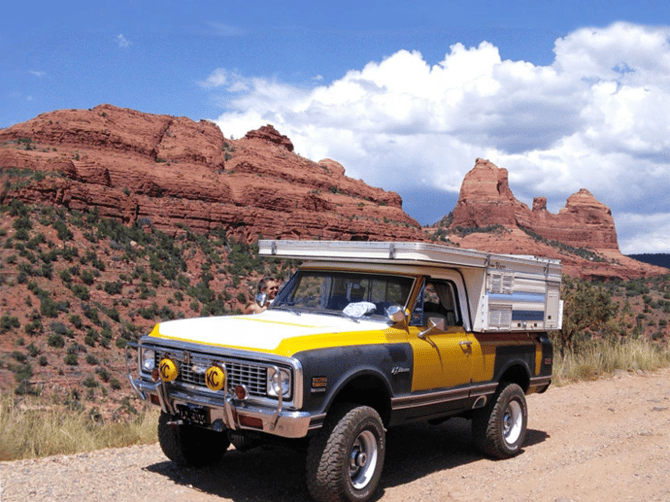
Our history has delivered enough twists and turns to fulfill many a grand adventure! After all the thrills and spills we feel fortunate to be among the few RV producers still standing since 1972. Now, as the world’s Pop-Up Truck Camper leader, and with the enthusiasm and guidance from our customers, we see blue skies and a clear path in our future.
As do many worthy outdoor endeavors, Four Wheel Campers was launched in Colorado. It was 1972 and Dave Rowe needed a way to go further off the beaten track. Vans had limitations, so he designed and built a hard-sided camper that could fit on a Scout, Blazer, or Bronco. The next evolution was to reduce weight via a pop-up style camper and design them to fit on standard pickup trucks.
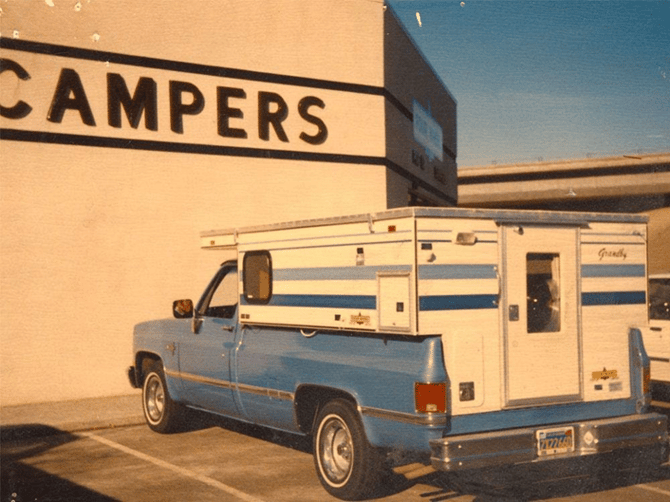
Everyone at Four Wheel Campers is grateful that the company developed and refined the pop-up design that defines our campers today. This design keeps weight low, improves aerodynamics, and allows for compact travel with full standing room at camp. From the beginning, it’s been a key reason our campers can handle decades of rugged, off-road adventure. This has translated to happy owners and consistently high resale values.
By 1989 the company moved to Woodland, CA, where it remains today. Back then, the term “Overlanding” was a reference to what was going on in Australia. By the mid 2000’s though, as an Overlanding lifestyle began gaining traction in the United States, the Four Wheel Campers product was a natural fit. The Overlanding market and community turned out to be our first specific, definable market. Over the years we have been fortunate to be closely involved with this dynamic group of people. As they have explored increasingly challenging terrain, their journeys have nudged us to continually improve.
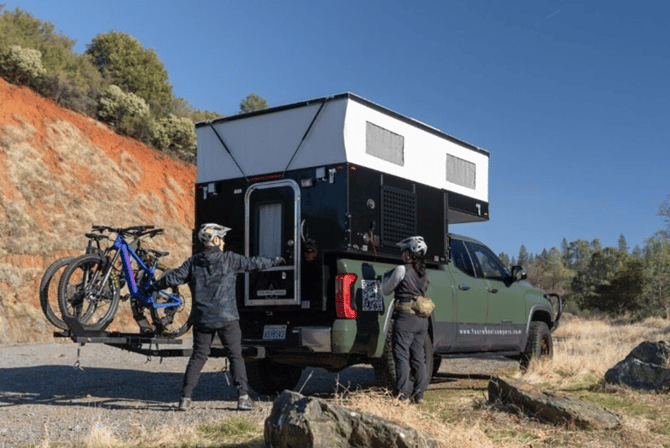
Looking ahead, a goal is to reach more people involved in a variety of outdoor activities. We serve campground campers, those navigating a mobile lifestyle, mountain bikers, surfers, paddle sport enthusiasts, birders, photographers, climbers, and people doing just about any outdoor activity you can think of. With all the talk about people hunkering over computers, it is our privilege to talk to and learn from these explorers and adventurers.
Through our dealers, annual customer rallies, social media, old fashioned phone calls, and factory visitors, we are listening and learning. We heartily thank our current and future customers, and we endeavor to focus on products and services that make your travels a bit more adventurous…and enjoyable!
Happy Adventures!